
PRESENTED BY
PRESENTED BY

Edgewise Therapeutics, Inc. (NASDAQ: EWTX)
Edgewise Therapeutics, Inc. (NASDAQ: EWTX)
Edgewise Therapeutics, Inc. (NASDAQ: EWTX)
By: OPIM Prosper Vista Accretion Long Bias SP
By: OPIM Prosper Vista Accretion Long Bias SP
Trade direction
Long equity (no hedge)
Long equity (no hedge)
Holding period
24 months
24 months
Date
3 June 2026
3 June 2026
Recommended Size
3–6%
3–6%
Target range
$70–85
$70–85
Implied Upside
Material (base case); higher in acquisition scenario
01 · executive summary
01 · executive summary
Edgewise Therapeutics is a clinical-stage cardiovascular biotechnology company. Following the announced sale of sevasemten and the muscular dystrophy franchise to Servier, EWTX is becoming a well-capitalized, focused cardiovascular platform. We recommend an unhedged long equity position sized at 3–6% of portfolio, with a 24-month target price of $70–85 per share and materially higher upside in a full acquisition scenario.
The alpha edge comes from our differentiated read of cardiology, cardiac pathophysiology, and clinical trial design. The market has treated EWTX as a complicated dual-franchise biotech and has, in our view, misread the atrial fibrillation signal in early EDG-7500 data. The Servier transaction validates the muscular dystrophy franchise, removes a non-core binary readout, and leaves a cleaner cardiovascular story centered on EDG-7500 and EDG-15400.
Edgewise Therapeutics is a clinical-stage cardiovascular biotechnology company. Following the announced sale of sevasemten and the muscular dystrophy franchise to Servier, EWTX is becoming a well-capitalized, focused cardiovascular platform. We recommend an unhedged long equity position sized at 3–6% of portfolio, with a 24-month target price of $70–85 per share and materially higher upside in a full acquisition scenario.
The alpha edge comes from our differentiated read of cardiology, cardiac pathophysiology, and clinical trial design. The market has treated EWTX as a complicated dual-franchise biotech and has, in our view, misread the atrial fibrillation signal in early EDG-7500 data. The Servier transaction validates the muscular dystrophy franchise, removes a non-core binary readout, and leaves a cleaner cardiovascular story centered on EDG-7500 and EDG-15400.
Interview
02 · Investment Thesis
02 · Investment Thesis
After following Edgewise closely, what stands out is the rare alignment among pipeline differentiation, development discipline, and capital allocation.
Our original 2025 thesis was built around two assets: sevasemten for Becker/Duchenne muscular dystrophy and EDG-7500 for hypertrophic cardiomyopathy, or HCM. In early June 2026, Edgewise agreed to sell the muscular dystrophy franchise to Servier for up to $2.65 billion. The transaction crystallizes value for sevasemten, strengthens the balance sheet through non-dilutive financing, and lets shareholders retain exposure to the higher-upside cardiovascular franchise.
Our first proprietary insight is that EDG-7500 should not be valued as a conventional cardiac myosin inhibitor, or CMI. CMIs such as mavacamten and aficamten have demonstrated efficacy in HCM, but their pharmacology is a double-edged sword: improved diastolic relaxation comes with negative inotropy. Patients may benefit from improved relaxation, but must also bear the risk of impaired systolic function and, in vulnerable patients, heart failure. This creates an inherently narrow therapeutic window.
That window limits CMIs in three ways. First, mavacamten requires repeated echocardiographic monitoring under a Risk Evaluation and Mitigation Strategy, or REMS, which is burdensome for many community cardiology practices. Second, mavacamten can only be used above specified ejection-fraction thresholds, while trials have generally enrolled patients with strong systolic reserve. Third, the limitation is sharper in nonobstructive HCM, or nHCM, where patients often have less room to tolerate negative inotropy. Although aficamten’s Phase 3 ACACIA-HCM study was statistically positive in nHCM, the KCCQ benefit was only about 3 points, limiting both clinical and commercial relevance.
EDG-7500’s core pharmacologic advantage is that it may deliver diastolic benefit without meaningful systolic impairment. If sustained in larger datasets, this would address the central limitation of CMIs and support a next-generation HCM profile. To date, EDG-7500 has been studied in more than 100 healthy volunteers and patients, with no meaningful LVEF drop signal. In Phase 2 Part B/C studies, EDG-7500 showed dose-dependent benefit across LVOT gradient, NT-proBNP, diastolic parameters, symptoms, and functional scores. In nHCM, despite small sample size, the KCCQ signal appears materially stronger than aficamten’s.
Our second proprietary insight is that the market’s interpretation of the atrial fibrillation, or AF, signal is too crude. The market saw 4 AF cases among 29 patients in an early HCM cohort and treated this as direct atrial or electrophysiologic toxicity. We think the broader pathophysiologic context supports a different model: in an HCM population already at elevated AF risk, flat-dose EDG-7500 may have produced a strong acute hemodynamic effect that triggered AF in susceptible patients.
The evidence fits this model. HCM itself is a high-AF-risk disease. Early proof-of-concept studies washed out beta blockers and calcium-channel blockers, both of which suppress atrial automaticity. EDG-7500 was initially given directly at a relatively high target dose, and rapid hemodynamic change in a stiff, hypertrophied heart can plausibly increase arrhythmia vulnerability. Finally, there is no evidence to date of chronic atrial toxicity; if anything, in a cardiomyopathy swine model, longer-term EDG-7500 treatment reduced atrial size, a signal directionally consistent with favorable remodeling.
Based on this model, the company’s Part D adjustments are rational: lower starting dose, slower titration, and ambulatory rhythm monitoring. These changes are designed to turn an active molecule into a clinically usable product by engineering around acute hemodynamic perturbation.
Our third proprietary insight is that EDG-15400 gives Edgewise a credible HFpEF option. HFpEF and HCM share diastolic dysfunction as a central pathophysiologic feature, while heart failure patients are unlikely to tolerate meaningful LVEF decline. That makes CMIs poorly suited for HFpEF, but leaves room for a non-negative-inotropic cardiac modulator. EDG-15400 remains in Phase 1 and has not yet disclosed clinical data, but if the mechanism translates, its strategic value could exceed that of a standard follow-on molecule.
Our fourth proprietary insight is management quality. Edgewise’s prior work in Becker muscular dystrophy demonstrated real clinical craft: natural history work to identify faster-progressing subgroups, testing NSAA in proof-of-concept studies, high rollover into extension studies, and disciplined pivotal-trial design. The same style is now visible in cardiology. The company is asking the right product-building questions: how to titrate, how to fit titration into workflow, how to avoid acute hemodynamic overshoot, and which endpoints map to physician decision-making.
Capital allocation reinforces the point. The neuromuscular and cardiology franchises had limited operational synergy. By selling a pre-pivotal-readout asset at an attractive price, Edgewise avoided a binary event, strengthened its balance sheet, and focused the company on the larger cardiovascular opportunity.
After following Edgewise closely, what stands out is the rare alignment among pipeline differentiation, development discipline, and capital allocation.
Our original 2025 thesis was built around two assets: sevasemten for Becker/Duchenne muscular dystrophy and EDG-7500 for hypertrophic cardiomyopathy, or HCM. In early June 2026, Edgewise agreed to sell the muscular dystrophy franchise to Servier for up to $2.65 billion. The transaction crystallizes value for sevasemten, strengthens the balance sheet through non-dilutive financing, and lets shareholders retain exposure to the higher-upside cardiovascular franchise.
Our first proprietary insight is that EDG-7500 should not be valued as a conventional cardiac myosin inhibitor, or CMI. CMIs such as mavacamten and aficamten have demonstrated efficacy in HCM, but their pharmacology is a double-edged sword: improved diastolic relaxation comes with negative inotropy. Patients may benefit from improved relaxation, but must also bear the risk of impaired systolic function and, in vulnerable patients, heart failure. This creates an inherently narrow therapeutic window.
That window limits CMIs in three ways. First, mavacamten requires repeated echocardiographic monitoring under a Risk Evaluation and Mitigation Strategy, or REMS, which is burdensome for many community cardiology practices. Second, mavacamten can only be used above specified ejection-fraction thresholds, while trials have generally enrolled patients with strong systolic reserve. Third, the limitation is sharper in nonobstructive HCM, or nHCM, where patients often have less room to tolerate negative inotropy. Although aficamten’s Phase 3 ACACIA-HCM study was statistically positive in nHCM, the KCCQ benefit was only about 3 points, limiting both clinical and commercial relevance.
EDG-7500’s core pharmacologic advantage is that it may deliver diastolic benefit without meaningful systolic impairment. If sustained in larger datasets, this would address the central limitation of CMIs and support a next-generation HCM profile. To date, EDG-7500 has been studied in more than 100 healthy volunteers and patients, with no meaningful LVEF drop signal. In Phase 2 Part B/C studies, EDG-7500 showed dose-dependent benefit across LVOT gradient, NT-proBNP, diastolic parameters, symptoms, and functional scores. In nHCM, despite small sample size, the KCCQ signal appears materially stronger than aficamten’s.
Our second proprietary insight is that the market’s interpretation of the atrial fibrillation, or AF, signal is too crude. The market saw 4 AF cases among 29 patients in an early HCM cohort and treated this as direct atrial or electrophysiologic toxicity. We think the broader pathophysiologic context supports a different model: in an HCM population already at elevated AF risk, flat-dose EDG-7500 may have produced a strong acute hemodynamic effect that triggered AF in susceptible patients.
The evidence fits this model. HCM itself is a high-AF-risk disease. Early proof-of-concept studies washed out beta blockers and calcium-channel blockers, both of which suppress atrial automaticity. EDG-7500 was initially given directly at a relatively high target dose, and rapid hemodynamic change in a stiff, hypertrophied heart can plausibly increase arrhythmia vulnerability. Finally, there is no evidence to date of chronic atrial toxicity; if anything, in a cardiomyopathy swine model, longer-term EDG-7500 treatment reduced atrial size, a signal directionally consistent with favorable remodeling.
Based on this model, the company’s Part D adjustments are rational: lower starting dose, slower titration, and ambulatory rhythm monitoring. These changes are designed to turn an active molecule into a clinically usable product by engineering around acute hemodynamic perturbation.
Our third proprietary insight is that EDG-15400 gives Edgewise a credible HFpEF option. HFpEF and HCM share diastolic dysfunction as a central pathophysiologic feature, while heart failure patients are unlikely to tolerate meaningful LVEF decline. That makes CMIs poorly suited for HFpEF, but leaves room for a non-negative-inotropic cardiac modulator. EDG-15400 remains in Phase 1 and has not yet disclosed clinical data, but if the mechanism translates, its strategic value could exceed that of a standard follow-on molecule.
Our fourth proprietary insight is management quality. Edgewise’s prior work in Becker muscular dystrophy demonstrated real clinical craft: natural history work to identify faster-progressing subgroups, testing NSAA in proof-of-concept studies, high rollover into extension studies, and disciplined pivotal-trial design. The same style is now visible in cardiology. The company is asking the right product-building questions: how to titrate, how to fit titration into workflow, how to avoid acute hemodynamic overshoot, and which endpoints map to physician decision-making.
Capital allocation reinforces the point. The neuromuscular and cardiology franchises had limited operational synergy. By selling a pre-pivotal-readout asset at an attractive price, Edgewise avoided a binary event, strengthened its balance sheet, and focused the company on the larger cardiovascular opportunity.
03 · Valuation & Catalysts
03 · Valuation & Catalysts
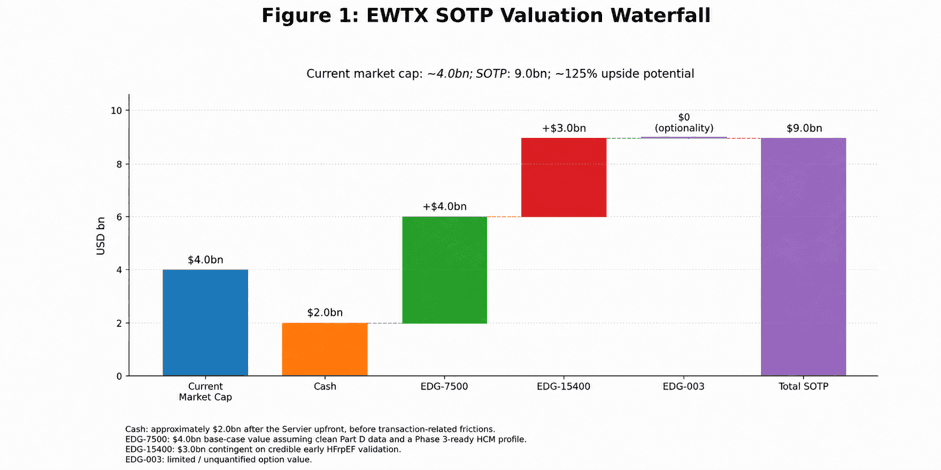
As of the close on 2 June 2026, EWTX had a market capitalization of approximately $4 billion. After receipt of the Servier upfront payment, and before transaction-related frictions, cash and marketable securities should approach $2 billion. This implies that the market values the remaining cardiovascular pipeline at only about $2 billion, while not fully recognizing up to $1.1 billion of potential sevasemten milestone value.
We believe this is too low. In our base case, EDG-7500 produces clean 12-week Part D data: no meaningful LVEF impairment, manageable AF under optimized titration, and consistent efficacy across hemodynamics, biomarkers, physician-assessed outcomes, and patient-reported outcomes. In that scenario, the market should value Edgewise as a focused HCM company with a Phase 3-ready asset. We assign $4 billion of value to EDG-7500. If EDG-15400 produces credible early HFpEF data, we believe it could be worth roughly $3 billion. A 2027 market capitalization of $7–9 billion is reasonable, corresponding to $70–85 per share.
In the bull case, if both EDG-7500 and EDG-15400 are validated, EWTX’s strategic value as a cardiac modulation platform becomes much clearer. In an acquisition scenario, $12–16 billion of strategic value is possible, corresponding to more than $110–150 per share.
Key catalysts over the next 24 months include: 12-week CIRRUS-HCM Part D data in 2026; initiation and finalization of EDG-7500’s Phase 3 HCM strategy; and advancement of EDG-15400 into Phase 2 development in HFpEF.
As of the close on 2 June 2026, EWTX had a market capitalization of approximately $4 billion. After receipt of the Servier upfront payment, and before transaction-related frictions, cash and marketable securities should approach $2 billion. This implies that the market values the remaining cardiovascular pipeline at only about $2 billion, while not fully recognizing up to $1.1 billion of potential sevasemten milestone value.
We believe this is too low. In our base case, EDG-7500 produces clean 12-week Part D data: no meaningful LVEF impairment, manageable AF under optimized titration, and consistent efficacy across hemodynamics, biomarkers, physician-assessed outcomes, and patient-reported outcomes. In that scenario, the market should value Edgewise as a focused HCM company with a Phase 3-ready asset. We assign $4 billion of value to EDG-7500. If EDG-15400 produces credible early HFpEF data, we believe it could be worth roughly $3 billion. A 2027 market capitalization of $7–9 billion is reasonable, corresponding to $70–85 per share.
In the bull case, if both EDG-7500 and EDG-15400 are validated, EWTX’s strategic value as a cardiac modulation platform becomes much clearer. In an acquisition scenario, $12–16 billion of strategic value is possible, corresponding to more than $110–150 per share.
Key catalysts over the next 24 months include: 12-week CIRRUS-HCM Part D data in 2026; initiation and finalization of EDG-7500’s Phase 3 HCM strategy; and advancement of EDG-15400 into Phase 2 development in HFpEF.
04 · Risks & Mitigation
04 · Risks & Mitigation
The risks fall into two categories: fundamental thesis risk and mark-to-market risk.
Fundamental thesis risk includes EDG-7500 showing weaker efficacy than CMIs, causing LVEF decline, or demonstrating a true mechanism-related AF liability rather than a dose-, titration-, or context-related signal. The definitive test is Phase 3 data. We believe the probability of full thesis failure is low, and we manage downside through position-size discipline.
Mark-to-market risk is mainly driven by the AF debate. The near-term number the market will trade is the Part D AF count. With approximately 60 patients, 3 AF cases would imply a 5% rate, while 6 cases would imply a 10% rate. This small numerical difference could dominate the headline even if it does not settle causality. If the market sells EWTX on a crude AF headline while the broader profile remains intact, we would view that as an attractive opportunity to add. With roughly $2 billion of cash after the transaction closes, downside should be relatively manageable outside a true thesis-disconfirming event.
The risks fall into two categories: fundamental thesis risk and mark-to-market risk.
Fundamental thesis risk includes EDG-7500 showing weaker efficacy than CMIs, causing LVEF decline, or demonstrating a true mechanism-related AF liability rather than a dose-, titration-, or context-related signal. The definitive test is Phase 3 data. We believe the probability of full thesis failure is low, and we manage downside through position-size discipline.
Mark-to-market risk is mainly driven by the AF debate. The near-term number the market will trade is the Part D AF count. With approximately 60 patients, 3 AF cases would imply a 5% rate, while 6 cases would imply a 10% rate. This small numerical difference could dominate the headline even if it does not settle causality. If the market sells EWTX on a crude AF headline while the broader profile remains intact, we would view that as an attractive opportunity to add. With roughly $2 billion of cash after the transaction closes, downside should be relatively manageable outside a true thesis-disconfirming event.
05 · Position Sizing & Portfolio Fit
05 · Position Sizing & Portfolio Fit
We recommend a 3–6% unhedged long equity position. This is a high-conviction biotech position driven by clinical catalysts, not a low-volatility compounder. It fits the portfolio as a focused, asymmetric biotech holding: downside is partially cushioned by cash, while upside comes from a cardiovascular asset that could define a new therapeutic category.
We recommend a 3–6% unhedged long equity position. This is a high-conviction biotech position driven by clinical catalysts, not a low-volatility compounder. It fits the portfolio as a focused, asymmetric biotech holding: downside is partially cushioned by cash, while upside comes from a cardiovascular asset that could define a new therapeutic category.
06 · Manager Skill Highlight
06 · Manager Skill Highlight
This idea reflects our core research edge: reading biotech through disease biology, cardiac pathophysiology, pharmacology, endpoint validity, and management behavior rather than through consensus narrative. The market sees an HCM drug with an AF concern. We see a differentiated cardiac sarcomere modulator, a newly focused corporate structure, and a management team that has demonstrated rational capital allocation.
This idea reflects our core research edge: reading biotech through disease biology, cardiac pathophysiology, pharmacology, endpoint validity, and management behavior rather than through consensus narrative. The market sees an HCM drug with an AF concern. We see a differentiated cardiac sarcomere modulator, a newly focused corporate structure, and a management team that has demonstrated rational capital allocation.
Optional Exhibit · Price & Volume
Optional Exhibit · Price & Volume

Conflicts Disclosure
Conflicts Disclosure
OPIM and/or its funds may currently hold or may acquire a long position in Edgewise Therapeutics. The above analysis is for illustrative and educational purposes only.
OPIM and/or its funds may currently hold or may acquire a long position in Edgewise Therapeutics. The above analysis is for illustrative and educational purposes only.
About Prosper Vista Accretion Long Bias SP & Nan Jiang
About Prosper Vista Accretion Long Bias SP & Nan Jiang
Prosper Vista Accretion Long Bias SP is a Cayman Islands segregated portfolio launched by OP Investment Management in May 2026. The Fund pursues a long-biased, research-driven equity strategy focused on Greater China (including Hong Kong and Taiwan), with selective exposure to global markets. It targets cyclical sectors such as energy, chemicals, manufacturing and utilities, seeking to build concentrated positions when industry cycles and valuations are depressed and to exit as conditions and valuations normalize. The strategy emphasizes bottom-up research, high-conviction portfolio construction and disciplined institutional risk controls.
Prosper Vista Accretion Long Bias SP is a Cayman Islands segregated portfolio launched by OP Investment Management in May 2026. The Fund pursues a long-biased, research-driven equity strategy focused on Greater China (including Hong Kong and Taiwan), with selective exposure to global markets. It targets cyclical sectors such as energy, chemicals, manufacturing and utilities, seeking to build concentrated positions when industry cycles and valuations are depressed and to exit as conditions and valuations normalize. The strategy emphasizes bottom-up research, high-conviction portfolio construction and disciplined institutional risk controls.
Nan Jiang is a Healthcare & Biotech investor at Prosper Vista Accretion Long Bias SP, working alongside Dyan Wang. A graduate of Peking Union Medical College, she brings a clinical perspective to biotech analysis and approaches the sector with a long-term, value-oriented mindset.
Nan Jiang is a Healthcare & Biotech investor at Prosper Vista Accretion Long Bias SP, working alongside Dyan Wang. A graduate of Peking Union Medical College, she brings a clinical perspective to biotech analysis and approaches the sector with a long-term, value-oriented mindset.

COPFA Alpha Showcase 2026
For Professional investors only
This website and the articles contained herein are prepared solely for purpose of educational and academic discussion among members of COPFA and the broader industry community. The content in this section is intended solely for readers of industry community who shall be Professional Investors (as defined under the Securities and Futures Ordinance of Hong Kong and its subsidiary legislation). If you are not a Professional Investors, please do not proceed. The China Overseas Private Funds Association (“COPFA”) is a non-profit industry association. The COPFA Alpha Showcase is an industry initiative to showcase high-quality investment thinking. COPFA does not provide investment advice and does not endorse, recommend or guarantee any specific investment idea, strategy, product, or manager. The views and opinions expressed in the articles are solely those of the individual contributing managers and do not represent the views of COPFA. The articles are provided for illustrative and educational purposes only and do not constitute investment, legal, tax or professional advice, nor do they constitute an offer to sell, or a solicitation to buy any securities or financial instruments in any jurisdiction. Where the contributing managers are licensed or regulated, such licensing status does not imply any verification or endorsement of the content by COPFA or the regulatory authorities. COPFA makes no representation or warranties, express or implied, as to the accuracy, completeness, timeliness, or reliability of the information contained herein. Past performance is not indicative of future results. Readers must not rely on any information or viewpoints contained herein to make any investment or business decisions. To the fullest extent permitted by law, COPFA, its directors, officers, employees, and the contributing authors/managers hereby expressly disclaim any and all liability for any direct, indirect, incidental, or consequential loss or damage arising from or in connection with the use of or reliance on this website or its contents. For professional investors only. Not for public distribution.
Copyright © COPFA. All rights reserved. No part of this website or information herein may be reproduced, distributed, or transmitted in any form without the prior written permission of COPFA.