PRESENTED BY
PRESENTED BY

Kingfa Sci. & Tech. (600143.SH)
Kingfa Sci. & Tech. (600143.SH)
Kingfa Sci. & Tech. (600143.SH)
By: Prosper Vista Accretion Long Bias SP
By: Prosper Vista Accretion Long Bias SP
Trade direction
Long-only
Long-only
Holding period
12–24 months
12–24 months
Upside
>100% (SOTP RMB 90–100bn)
>100% (SOTP RMB 90–100bn)
Recommended Size
5–10%
5–10%
Date
1 June 2026
1 June 2026
Key Hook
Undervalued new-materials platform inside a misclassified commodity name
01 · executive summary
01 · executive summary
Kingfa Sci. & Tech. (600143.SH) is the world's largest modified-plastics manufacturer, but its real value does not lie in this "commodity core business"; rather, it lies in a new-materials platform that is unique in China for having integrated the full "synthesis + modification" chain and is now scaling rapidly. We are long Kingfa with a 12-24 month holding period. Our target price implies more than 100% upside from the current market capitalization of roughly RMB 40bn.
Excess return will come from volume growth and revaluation of Kingfa's new-materials platform. Kingfa's new-materials business covers LCP, high-temperature nylon, PEEK, PPSU, carbon-fiber composites and other high-barrier materials. Its products span high-growth end-markets including AI servers, humanoid robots, the low-altitude economy and automotive electronics. In 2025, this business already generated gross profit at the RMB 1bn level (CAGR of 50%). Management's target is to lift revenue contribution from less than 10% currently to 30%, corresponding to an RMB 30bn revenue scale. We believe this high-margin, high-growth platform is being systematically undervalued by the market, and that it is the root of the company's potential to double.
Kingfa Sci. & Tech. (600143.SH) is the world’s largest modified-plastics manufacturer, but its real value does not lie in this “commodity core business”; rather, it lies in a new-materials platform that is unique in China for having integrated the full “synthesis + modification” chain and is now scaling rapidly. We are long Kingfa with a 12-24 month holding period. Our target price implies more than 100% upside from the current market capitalization of roughly RMB 40bn.
Excess return will come from volume growth and revaluation of Kingfa’s new-materials platform. Kingfa’s new-materials business covers LCP, high-temperature nylon, PEEK, PPSU, carbon-fiber composites and other high-barrier materials. Its products span high-growth end-markets including AI servers, humanoid robots, the low-altitude economy and automotive electronics. In 2025, this business already generated gross profit at the RMB 1bn level (CAGR of 50%). Management’s target is to lift revenue contribution from less than 10% currently to 30%, corresponding to an RMB 30bn revenue scale. We believe this high-margin, high-growth platform is being systematically undervalued by the market, and that it is the root of the company’s potential to double.
Interview
02 · Investment Thesis
02 · Investment Thesis
The cognitive gap stems from Kingfa's reporting structure, which happens to conceal its most valuable part. Of 2025 revenue of RMB 65.4bn, modified plastics (55%) and green petrochemicals (19%) are the largest and most visible commodity businesses. The former is viewed as a cyclical processing business whose profitability rises and falls with resin prices; the latter has lost money for five consecutive years and dragged reported ROIC down to 3%. Quantitative screens and sell-side coverage therefore naturally classify Kingfa as a "commodity cyclical stock" and apply only commodity valuation multiples. Yet the new-materials business that is genuinely changing the company's value is too small in reported size and is completely drowned out by the noise from commodity businesses. In other words, the market's neglect of Kingfa's transition is the key foundation of this investment.
Three profit drivers are likely to resonate within our holding period.
First and most underappreciated: specialty materials ramping in AI and robotics. Kingfa's competitiveness lies in being the only domestic platform that has both upstream polymerization and downstream modification capabilities, as well as a structural-design team. This allows it to work with customers on integrated "material + structure" customized development. In addition, it benefits from scheduling advantages brought by average order sizes above 30,000 tonnes (a 10-15% cost advantage versus peers) and a steep cost-reduction curve after scale-up (LCP unit cost fell from RMB 40,000/t to RMB 27,000/t within one year, a 32.5% reduction). As a result, product R&D efficiency and gross margin continue to lead peers.
AI servers are the most certain near-term source of volume growth. Kingfa has more than 40% market share in LCP for high-speed connectors and is the only LCP solution supplier on the raw-material side for NVIDIA GB200/GB300 (even materials used by second-source Luxshare are connected through Kingfa). It also holds 30-90% share in DDR memory, CPU sockets and other areas, and has completed DDR6 material development and customer certification for next-generation PPS thermal-management solutions. Long-term, stable co-development and supply capabilities form Kingfa's moat.
Robotics offers a longer-term and more elastic opportunity. Kingfa has entered leading customers such as Yu X, You Xuan and Te XX. Its material solutions cover almost all key components, from skeletons (high-temperature/long-chain nylon), gear and harmonic-drive components (PEEK replacing steel), exoskeletons (carbon-fiber composites with 70% market share) to electronic skin (TPU). To enter the home, humanoid robots must be substantially lightweighted; "replacing steel with plastics" is the only path. Plastic content per robot will therefore increase, tightly linking Kingfa's material demand to robot production volume.
Today this business is still small, but its real value lies in how it scales. AI and robotics materials are design-in materials with certification cycles of 1.5-3 years: the certification threshold is high, replacement is extremely difficult once the material is designed in, and shipments will ramp in lockstep with customers' product volume curves, producing step-changes in earnings. This non-linear elasticity is exactly what the market misses when it evaluates the business by its "static revenue contribution."
Second, the modified-plastics product mix is upgrading. Historically, peers mainly engaged in general-purpose modification of externally purchased resin. Kingfa, by contrast, consciously upgraded its product structure a decade ago and entered engineering-grade modification based on self-produced synthetic resins. The gross-margin gap between the two product categories is 10-20 percentage points. Engineering-grade products as a share of the modified-plastics mix have increased from 15% in 2018 to roughly 30%, driving steady improvement in consolidated gross margin. This is the fundamental reason why Kingfa's consolidated gross margin has long been 5-10 percentage points higher than general-material peers such as Guoen and Dawn. In addition, Kingfa was one of the earliest companies in the industry to expand overseas. Overseas business now accounts for 16% of revenue; 2025 sales volume increased 27%; and gross margin carries a 3-5 percentage point premium, further reinforcing the margin-improvement trend.
Third, petrochemical losses are narrowing. The PDH/PP/ABS expansion has been completed and capital expenditure is receding. Petrochemical products are primarily consumed internally by the modified-plastics business, which gives the segment assured demand, and the company maintains utilization far above peers during an industry downturn. Taking Ningbo Kingfa's PP unit as an example, current operating load is as high as 134%, far above the industry average of around 60%, with processing costs more than 30% lower than the industry. More importantly, upstream and modification capabilities are continuously integrated through Ningbo Kingfa and Liaoning Kingfa, the company's two petrochemical subsidiaries. More self-produced PP is being consumed by the internal modified-plastics business, while outbound products are shifting from commodity grades such as ordinary ABS to specialty and differentiated grades (targeting more than 70% specialty-grade contribution). The "liquid-to-solid" route (propylene to modified materials) increases value added. As depreciation and impairment provisions are completed, both petrochemical subsidiaries are clearly expected to reach breakeven by 2028.
The cognitive gap stems from Kingfa’s reporting structure, which happens to conceal its most valuable part. Of 2025 revenue of RMB 65.4bn, modified plastics (55%) and green petrochemicals (19%) are the largest and most visible commodity businesses. The former is viewed as a cyclical processing business whose profitability rises and falls with resin prices; the latter has lost money for five consecutive years and dragged reported ROIC down to 3%. Quantitative screens and sell-side coverage therefore naturally classify Kingfa as a “commodity cyclical stock” and apply only commodity valuation multiples. Yet the new-materials business that is genuinely changing the company’s value is too small in reported size and is completely drowned out by the noise from commodity businesses. In other words, the market’s neglect of Kingfa’s transition is the key foundation of this investment.
Three profit drivers are likely to resonate within our holding period.
First and most underappreciated: specialty materials ramping in AI and robotics. Kingfa’s competitiveness lies in being the only domestic platform that has both upstream polymerization and downstream modification capabilities, as well as a structural-design team. This allows it to work with customers on integrated “material + structure” customized development. In addition, it benefits from scheduling advantages brought by average order sizes above 30,000 tonnes (a 10-15% cost advantage versus peers) and a steep cost-reduction curve after scale-up (LCP unit cost fell from RMB 40,000/t to RMB 27,000/t within one year, a 32.5% reduction). As a result, product R&D efficiency and gross margin continue to lead peers.
AI servers are the most certain near-term source of volume growth. Kingfa has more than 40% market share in LCP for high-speed connectors and is the only LCP solution supplier on the raw-material side for NVIDIA GB200/GB300 (even materials used by second-source Luxshare are connected through Kingfa). It also holds 30-90% share in DDR memory, CPU sockets and other areas, and has completed DDR6 material development and customer certification for next-generation PPS thermal-management solutions. Long-term, stable co-development and supply capabilities form Kingfa’s moat.
Robotics offers a longer-term and more elastic opportunity. Kingfa has entered leading customers such as Yu X, You Xuan and Te XX. Its material solutions cover almost all key components, from skeletons (high-temperature/long-chain nylon), gear and harmonic-drive components (PEEK replacing steel), exoskeletons (carbon-fiber composites with 70% market share) to electronic skin (TPU). To enter the home, humanoid robots must be substantially lightweighted; “replacing steel with plastics” is the only path. Plastic content per robot will therefore increase, tightly linking Kingfa’s material demand to robot production volume.
Today this business is still small, but its real value lies in how it scales. AI and robotics materials are design-in materials with certification cycles of 1.5-3 years: the certification threshold is high, replacement is extremely difficult once the material is designed in, and shipments will ramp in lockstep with customers’ product volume curves, producing step-changes in earnings. This non-linear elasticity is exactly what the market misses when it evaluates the business by its “static revenue contribution.”
Second, the modified-plastics product mix is upgrading. Historically, peers mainly engaged in general-purpose modification of externally purchased resin. Kingfa, by contrast, consciously upgraded its product structure a decade ago and entered engineering-grade modification based on self-produced synthetic resins. The gross-margin gap between the two product categories is 10-20 percentage points. Engineering-grade products as a share of the modified-plastics mix have increased from 15% in 2018 to roughly 30%, driving steady improvement in consolidated gross margin. This is the fundamental reason why Kingfa’s consolidated gross margin has long been 5-10 percentage points higher than general-material peers such as Guoen and Dawn. In addition, Kingfa was one of the earliest companies in the industry to expand overseas. Overseas business now accounts for 16% of revenue; 2025 sales volume increased 27%; and gross margin carries a 3-5 percentage point premium, further reinforcing the margin-improvement trend.
Third, petrochemical losses are narrowing. The PDH/PP/ABS expansion has been completed and capital expenditure is receding. Petrochemical products are primarily consumed internally by the modified-plastics business, which gives the segment assured demand, and the company maintains utilization far above peers during an industry downturn. Taking Ningbo Kingfa’s PP unit as an example, current operating load is as high as 134%, far above the industry average of around 60%, with processing costs more than 30% lower than the industry. More importantly, upstream and modification capabilities are continuously integrated through Ningbo Kingfa and Liaoning Kingfa, the company’s two petrochemical subsidiaries. More self-produced PP is being consumed by the internal modified-plastics business, while outbound products are shifting from commodity grades such as ordinary ABS to specialty and differentiated grades (targeting more than 70% specialty-grade contribution). The “liquid-to-solid” route (propylene to modified materials) increases value added. As depreciation and impairment provisions are completed, both petrochemical subsidiaries are clearly expected to reach breakeven by 2028.
03 · Valuation & Catalysts
03 · Valuation & Catalysts
The most controversial point, and the one most investors refuse to accept, is that the market is applying "commodity cyclical" multiples to a company that is becoming a high-margin new-materials platform. We use sum-of-the-parts (SOTP) valuation to break down this cognitive gap.
First layer - the modified-plastics core business. 2025 net profit was RMB 3.5bn. With a 10% CAGR over the next two years, net profit should reach RMB 4.2bn in 2028. Applying a conservative 15x P/E implies roughly RMB 63.5bn of value, already about 40% above the current RMB 40bn market capitalization. It is worth emphasizing that this multiple is conservative: general-material peers Guoen, Dawn and Huitong trade at 12-18x, despite gross margins 5-10 percentage points lower than Kingfa's and no vertical integration.
Second layer - the new-materials platform, which the market treats as worth zero. Translating the scaling logic into numbers: AI specialty materials generated RMB 0.8bn of revenue in 2025, with a medium-term CAGR of 50%. Together with continued growth in specialty engineering plastics, biodegradable plastics and carbon-fiber composites, new-materials segment revenue is expected to reach around RMB 9bn in 2028. As high-margin products (AI/specialty materials with 40-50% gross margins) increase their mix, segment gross margin could reach 30-40% and net margin 15-18%, corresponding to about RMB 1.3-1.6bn of net profit. Compared with pure-play LCP company Wote and pure-play PEEK company Zhongyan at 25-30x, even a conservative 20-25x multiple implies incremental value of roughly RMB 26-40bn.
The robotics ramp is additional upside on top of this. In the 2028 transition period, assuming about 12kg of plastics/composites per robot (between the current 3.5kg and the 2030 target of 18kg), a blended ASP of RMB 120,000-150,000/t (with PEEK and carbon fiber lifting the average), around 400,000 global humanoid units, and a 30% Kingfa market share, humanoids alone would add roughly RMB 0.2bn of revenue and RMB 0.1bn of profit. By 2030, assuming 3mn global units, 18kg per unit, RMB 135,000/t ASP and 30% share, humanoids would represent around RMB 2.2bn of revenue. Together with the mature non-humanoid business, the robotics segment could reach RMB 4bn of revenue and about RMB 0.4bn of net profit. Relative to the company's 2030 target for the new-materials segment of RMB 30bn revenue and RMB 4.5-5.4bn net profit, the platform's long-term incremental value could reach the RMB 100bn scale.
Third layer - green petrochemicals returning to breakeven. The PDH unit lost RMB 1.8bn/RMB 1.7bn/RMB 1.6bn in 2023/2024/2025. With the PDH/PP/ABS expansion completed, capital expenditure receding and upstream/modification integration reducing costs (internal consumption of PP and higher specialty-grade mix), company guidance points to breakeven in 2028. We do not assign this segment a standalone P/E valuation; its value is reflected indirectly through removing the drag on consolidated earnings.
Total SOTP is roughly RMB 90-100bn, implying more than 100% upside from the current market capitalization.
Key catalysts over the next 12-24 months: (1) higher mix of engineering plastics and overseas sales, product-mix optimization and margin improvement; (2) GB300 ramp and new design wins in humanoid robots, with quarterly specialty-materials volume (already 9,100 tonnes in 2026Q1 and still accelerating) further lifting gross profit; (3) sustained positive free cash flow, opening room for higher dividends; and (4) progress toward petrochemical breakeven, constrained by the pace of rebalancing in propylene supply and demand.
The most controversial point, and the one most investors refuse to accept, is that the market is applying “commodity cyclical” multiples to a company that is becoming a high-margin new-materials platform. We use sum-of-the-parts (SOTP) valuation to break down this cognitive gap.
First layer - the modified-plastics core business. 2025 net profit was RMB 3.5bn. With a 10% CAGR over the next two years, net profit should reach RMB 4.2bn in 2028. Applying a conservative 15x P/E implies roughly RMB 63.5bn of value, already about 40% above the current RMB 40bn market capitalization. It is worth emphasizing that this multiple is conservative: general-material peers Guoen, Dawn and Huitong trade at 12-18x, despite gross margins 5-10 percentage points lower than Kingfa’s and no vertical integration.
Second layer - the new-materials platform, which the market treats as worth zero. Translating the scaling logic into numbers: AI specialty materials generated RMB 0.8bn of revenue in 2025, with a medium-term CAGR of 50%. Together with continued growth in specialty engineering plastics, biodegradable plastics and carbon-fiber composites, new-materials segment revenue is expected to reach around RMB 9bn in 2028. As high-margin products (AI/specialty materials with 40-50% gross margins) increase their mix, segment gross margin could reach 30-40% and net margin 15-18%, corresponding to about RMB 1.3-1.6bn of net profit. Compared with pure-play LCP company Wote and pure-play PEEK company Zhongyan at 25-30x, even a conservative 20-25x multiple implies incremental value of roughly RMB 26-40bn.
The robotics ramp is additional upside on top of this. In the 2028 transition period, assuming about 12kg of plastics/composites per robot (between the current 3.5kg and the 2030 target of 18kg), a blended ASP of RMB 120,000-150,000/t (with PEEK and carbon fiber lifting the average), around 400,000 global humanoid units, and a 30% Kingfa market share, humanoids alone would add roughly RMB 0.2bn of revenue and RMB 0.1bn of profit. By 2030, assuming 3mn global units, 18kg per unit, RMB 135,000/t ASP and 30% share, humanoids would represent around RMB 2.2bn of revenue. Together with the mature non-humanoid business, the robotics segment could reach RMB 4bn of revenue and about RMB 0.4bn of net profit. Relative to the company’s 2030 target for the new-materials segment of RMB 30bn revenue and RMB 4.5-5.4bn net profit, the platform’s long-term incremental value could reach the RMB 100bn scale.
Third layer - green petrochemicals returning to breakeven. The PDH unit lost RMB 1.8bn/RMB 1.7bn/RMB 1.6bn in 2023/2024/2025. With the PDH/PP/ABS expansion completed, capital expenditure receding and upstream/modification integration reducing costs (internal consumption of PP and higher specialty-grade mix), company guidance points to breakeven in 2028. We do not assign this segment a standalone P/E valuation; its value is reflected indirectly through removing the drag on consolidated earnings.
Total SOTP is roughly RMB 90-100bn, implying more than 100% upside from the current market capitalization.
Key catalysts over the next 12-24 months: (1) higher mix of engineering plastics and overseas sales, product-mix optimization and margin improvement; (2) GB300 ramp and new design wins in humanoid robots, with quarterly specialty-materials volume (already 9,100 tonnes in 2026Q1 and still accelerating) further lifting gross profit; (3) sustained positive free cash flow, opening room for higher dividends; and (4) progress toward petrochemical breakeven, constrained by the pace of rebalancing in propylene supply and demand.
04 · Risks & Mitigation
04 · Risks & Mitigation
The timing of petrochemical breakeven is the most obvious risk. Propane and PP/ABS prices are affected by overcapacity. Our hedge is that SOTP values the equity only on the modified-plastics core business, so petrochemical breakeven is an upside option rather than a pillar of the thesis. Our proprietary propylene model also points to gradual rebalancing after 2028.
Commodity-material oversupply and slowing auto demand: peers continue to expand commodity materials in 2026-2027 (Guoen from 1.2mn tonnes to 2.0mn tonnes and Dawn from 0.47mn tonnes to 0.70mn tonnes, according to the companies' own disclosures). In addition, the exit of NEV purchase-tax exemptions could pressure auto demand. But this is precisely the segment where Kingfa is continuing to upgrade toward higher-end products. Peer capacity expansion in fact validates our product-structure-upgrade logic. Our proprietary auto model already assumes a conservative volume growth rate of about 10% (versus a 20-30% CAGR over the past three years).
Overall, in a pair-trade framework, shorting a peer basket would theoretically strip out industry beta and leave specialty-materials alpha. However, because A-share securities-lending availability for individual stocks is limited, this is difficult to implement fully in practice. We therefore focus on a long-only position and anchor downside protection mainly in the valuation floor of the modified-plastics core business.
The timing of petrochemical breakeven is the most obvious risk. Propane and PP/ABS prices are affected by overcapacity. Our hedge is that SOTP values the equity only on the modified-plastics core business, so petrochemical breakeven is an upside option rather than a pillar of the thesis. Our proprietary propylene model also points to gradual rebalancing after 2028.
Commodity-material oversupply and slowing auto demand: peers continue to expand commodity materials in 2026-2027 (Guoen from 1.2mn tonnes to 2.0mn tonnes and Dawn from 0.47mn tonnes to 0.70mn tonnes, according to the companies’ own disclosures). In addition, the exit of NEV purchase-tax exemptions could pressure auto demand. But this is precisely the segment where Kingfa is continuing to upgrade toward higher-end products. Peer capacity expansion in fact validates our product-structure-upgrade logic. Our proprietary auto model already assumes a conservative volume growth rate of about 10% (versus a 20-30% CAGR over the past three years).
Overall, in a pair-trade framework, shorting a peer basket would theoretically strip out industry beta and leave specialty-materials alpha. However, because A-share securities-lending availability for individual stocks is limited, this is difficult to implement fully in practice. We therefore focus on a long-only position and anchor downside protection mainly in the valuation floor of the modified-plastics core business.
05 · Position Sizing & Portfolio Fit
05 · Position Sizing & Portfolio Fit
We recommend a 5-10% allocation as a high-conviction core holding. Liquidity is ample (large-cap stock with a market capitalization of around RMB 40bn), supporting full position building and exit. The role of this position is "deep-value floor + embedded growth option": downside is supported by the SOTP valuation floor of the modified-plastics business, while the specialty-materials and robotics platform provides convex, multi-year asymmetric upside and diversifies well against cyclical exposures in the portfolio.
We recommend a 5-10% allocation as a high-conviction core holding. Liquidity is ample (large-cap stock with a market capitalization of around RMB 40bn), supporting full position building and exit. The role of this position is “deep-value floor + embedded growth option”: downside is supported by the SOTP valuation floor of the modified-plastics business, while the specialty-materials and robotics platform provides convex, multi-year asymmetric upside and diversifies well against cyclical exposures in the portfolio.
06 · Manager Skill Highlight
06 · Manager Skill Highlight
We focus on bottom-up, first-hand research into China's new-materials supply chain. We have tracked this industry for decades across three levels. First, we maintain long-term relationships with multiple companies in the modified-plastics industry and track changes in the industry's overall competitive landscape and cycle position. Second, we communicate closely with R&D and sales personnel within the industry to monitor order progress and the validation and penetration of new products. Third, we monitor upstream raw-material suppliers and downstream application customers to cross-check key information. This system allows us to identify spec-in progress before formal certification is completed, which is a leading indicator of specialty-material volume growth, and to independently confirm Kingfa's core supplier status across many high-end specialty materials. We have also built two proprietary models that turn the market's two biggest controversies from "guesswork" into falsifiable propositions: an auto-demand model (because the company derives around 50% of sales volume from autos, enabling us to track core-business stability in real time rather than relying on lagging industry data), and a propylene-supply model based on the timing of environmental-impact-assessment approvals to infer the path toward petrochemical breakeven.
We focus on bottom-up, first-hand research into China’s new-materials supply chain. We have tracked this industry for decades across three levels. First, we maintain long-term relationships with multiple companies in the modified-plastics industry and track changes in the industry’s overall competitive landscape and cycle position. Second, we communicate closely with R&D and sales personnel within the industry to monitor order progress and the validation and penetration of new products. Third, we monitor upstream raw-material suppliers and downstream application customers to cross-check key information. This system allows us to identify spec-in progress before formal certification is completed, which is a leading indicator of specialty-material volume growth, and to independently confirm Kingfa’s core supplier status across many high-end specialty materials. We have also built two proprietary models that turn the market’s two biggest controversies from “guesswork” into falsifiable propositions: an auto-demand model (because the company derives around 50% of sales volume from autos, enabling us to track core-business stability in real time rather than relying on lagging industry data), and a propylene-supply model based on the timing of environmental-impact-assessment approvals to infer the path toward petrochemical breakeven.
Appendix Figures
Appendix Figures
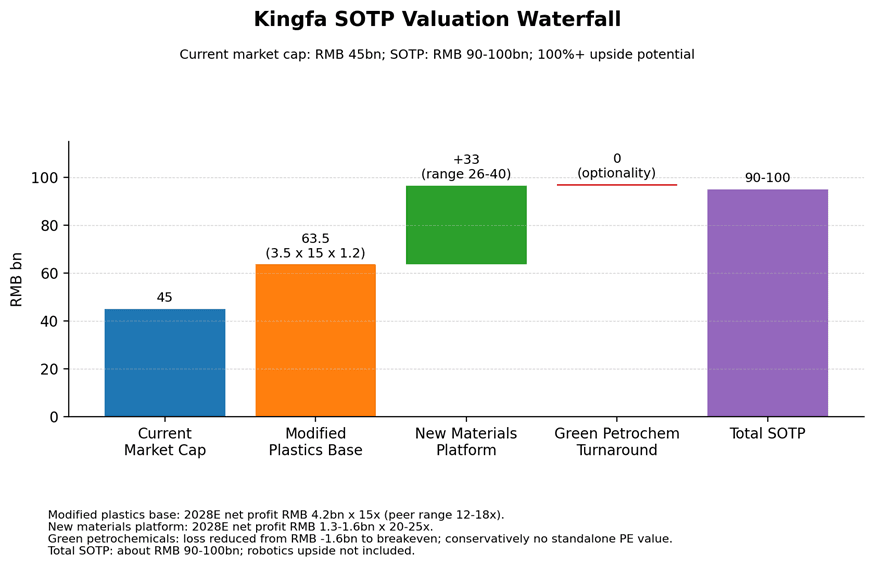
Figure 1: Kingfa SOTP Valuation Waterfall - Base Business RMB 63.5bn + New Materials RMB 26-40bn + Petrochemical Turnaround (Removal of Drag)

Figure 2: Kingfa vs. Guoen/Dawn Modified-Plastics Gross-Margin Comparison (Structural Spread)
Conflicts Disclosure
Conflicts Disclosure
OPIM Prosper Vista Accretion SPC and/or its funds may hold, or may opportunistically purchase, long positions in Kingfa Sci. & Tech. (600143.SH). This case study is for illustrative and educational purposes only and does not constitute investment advice or solicitation. It reflects the author's views as of June 1, 2026.
OPIM Prosper Vista Accretion SPC and/or its funds may hold, or may opportunistically purchase, long positions in Kingfa Sci. & Tech. (600143.SH). This case study is for illustrative and educational purposes only and does not constitute investment advice or solicitation. It reflects the author’s views as of June 1, 2026.
About Prosper Vista Accretion Long Bias SP & Dyan Wang
About Prosper Vista Accretion Long Bias SP & Dyan Wang
Prosper Vista Accretion Long Bias SP is a Cayman Islands segregated portfolio launched by OP Investment Management in May 2026. The Fund pursues a long-biased, research-driven equity strategy focused on Greater China (including Hong Kong and Taiwan), with selective exposure to global markets. It targets cyclical sectors such as energy, chemicals, manufacturing and utilities, seeking to build concentrated positions when industry cycles and valuations are depressed and to exit as conditions and valuations normalize. The strategy emphasizes bottom-up research, high-conviction portfolio construction and disciplined institutional risk controls.
Prosper Vista Accretion Long Bias SP is a Cayman Islands segregated portfolio launched by OP Investment Management in May 2026. The Fund pursues a long-biased, research-driven equity strategy focused on Greater China (including Hong Kong and Taiwan), with selective exposure to global markets. It targets cyclical sectors such as energy, chemicals, manufacturing and utilities, seeking to build concentrated positions when industry cycles and valuations are depressed and to exit as conditions and valuations normalize. The strategy emphasizes bottom-up research, high-conviction portfolio construction and disciplined institutional risk controls.
Dyan Wang is Director and Portfolio Manager of Prosper Vista Accretion Long Bias SP. She has over a decade of experience managing long-only Greater China equities, with a focus on identifying businesses with durable competitive strengths trading below intrinsic value. Her investment approach prioritizes deep fundamental research, selective capital allocation and a long-term ownership mindset, particularly within cyclical industries.
Dyan Wang is Director and Portfolio Manager of Prosper Vista Accretion Long Bias SP. She has over a decade of experience managing long-only Greater China equities, with a focus on identifying businesses with durable competitive strengths trading below intrinsic value. Her investment approach prioritizes deep fundamental research, selective capital allocation and a long-term ownership mindset, particularly within cyclical industries.

COPFA Alpha Showcase 2026
For Professional investors only
This website and the articles contained herein are prepared solely for purpose of educational and academic discussion among members of COPFA and the broader industry community. The content in this section is intended solely for readers of industry community who shall be Professional Investors (as defined under the Securities and Futures Ordinance of Hong Kong and its subsidiary legislation). If you are not a Professional Investors, please do not proceed. The China Overseas Private Funds Association (“COPFA”) is a non-profit industry association. The COPFA Alpha Showcase is an industry initiative to showcase high-quality investment thinking. COPFA does not provide investment advice and does not endorse, recommend or guarantee any specific investment idea, strategy, product, or manager. The views and opinions expressed in the articles are solely those of the individual contributing managers and do not represent the views of COPFA. The articles are provided for illustrative and educational purposes only and do not constitute investment, legal, tax or professional advice, nor do they constitute an offer to sell, or a solicitation to buy any securities or financial instruments in any jurisdiction. Where the contributing managers are licensed or regulated, such licensing status does not imply any verification or endorsement of the content by COPFA or the regulatory authorities. COPFA makes no representation or warranties, express or implied, as to the accuracy, completeness, timeliness, or reliability of the information contained herein. Past performance is not indicative of future results. Readers must not rely on any information or viewpoints contained herein to make any investment or business decisions. To the fullest extent permitted by law, COPFA, its directors, officers, employees, and the contributing authors/managers hereby expressly disclaim any and all liability for any direct, indirect, incidental, or consequential loss or damage arising from or in connection with the use of or reliance on this website or its contents. For professional investors only. Not for public distribution.
Copyright © COPFA. All rights reserved. No part of this website or information herein may be reproduced, distributed, or transmitted in any form without the prior written permission of COPFA.